
From Keywords To An Intent Based Strategy
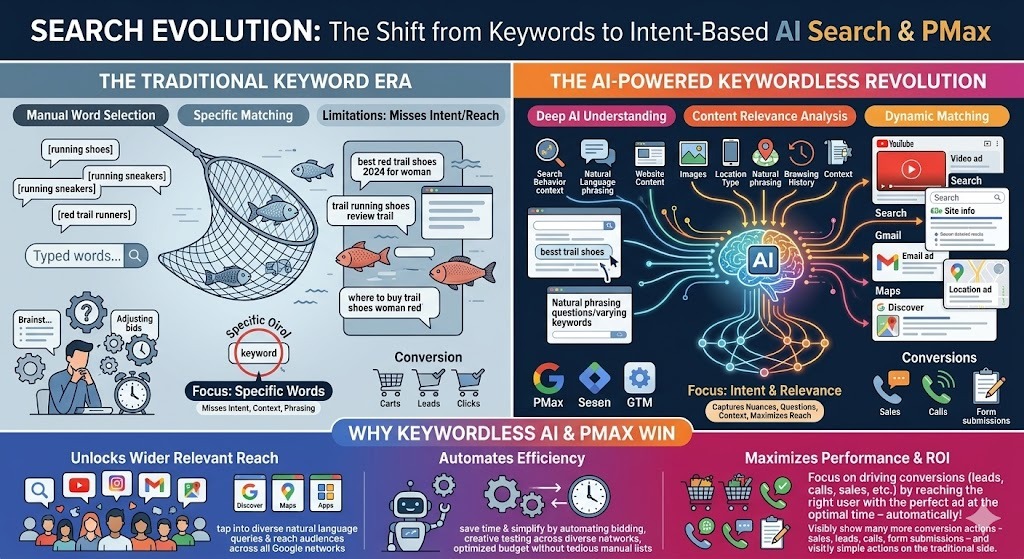
Traditional Keyword Targeting: The Literal Match
- How it works: Advertisers manually brainstorm, select, and bid on specific words or phrases (e.g., “buy running shoes”). The search engine triggers your ad when a user types those exact terms or close semantic variations into the search bar.
- The Focus: It relies on explicit text matching. You are targeting the exact words the user is typing.
- The Limitation: It focuses on the “what” rather than the “why.” Traditional keywords struggle to capture the nuance of long, conversational questions or the context behind the search, which can severely limit your reach and cause you to miss out on highly qualified, nuanced traffic.
Keywordless (AI) Targeting: The Intent Match
- How it works: Systems like AI Max and Performance Max pivot away from manual keyword lists and focus purely on user intent. Keywordless targeting leverages your non-keyword assets—specifically the rich content, structured data, and context of your website’s landing pages—to match with potential customers.
- The Focus: The AI evaluates a vast array of real-time signals (natural language phrasing, location, device, browsing behavior, and the content of an AI-generated response) to understand the meaning and intent behind the user’s search.
- The Advantage: Using features like “Final URL Expansion,” the AI dynamically crawls your site to find the exact landing page that perfectly answers the user’s highly specific query. This allows your ads to automatically tailor themselves in real-time, capturing billions of net new queries that traditional keyword lists would never catch.
Summary Comparison
| Feature | Traditional Keyword | Keywordless (AI & PMax) |
| Trigger | Exact or closely related words typed by the user. | The underlying intent and context of the user’s question. |
| Input Required | Manual lists, constant bid adjustments, negative keyword management. | High-quality landing pages, structured data (Schema), and conversion goals. |
| Matching Process | Literal text matching. | Dynamic matching using AI to evaluate complex behavior and content signals. |
| Reach & Scale | Limited to the specific variations you thought to include. | Unlocks massive reach across diverse networks (Search, YouTube, Maps, etc.) by automatically adapting to nuanced, natural language queries. |
Discovery And Onboarding Calls For Clients Resistant To The “Keywordless” Shift.
Phase 1: Validate and Reframe
Do not start by telling them keywords are dead. Start by validating their experience, then pivot the conversation to how consumer behavior has evolved.
- Acknowledge their expertise: Start by agreeing that their historical keyword strategy is exactly what built their current success.
- Introduce the shift: Explain that users are no longer just typing two-word phrases; they are asking complex, conversational questions to AI assistants.
- Reframe the goal: Shift the focus from “buying words” to “capturing intent.” Explain that modern AI Search Experiences look past the “what” of a query to understand the “why” and “what next,” allowing you to reach users you would have previously missed.
Phase 2: Tackle the Objections Head-On
Keyword-focused clients usually share the same core fears. Address these proactively with candid, fact-based responses.
- Objection: “I am losing control of my campaigns.”
- Your Response: You are not losing control; you are shifting where you exert control. Instead of micromanaging spreadsheets of words, you will control the AI by feeding it robust structured data, high-quality landing pages, and precise business goals.
- Objection: “How do I know what my ads will look like?”
- Your Response: Explain that ads now dynamically generate context bridges to explain exactly why your product answers the user’s specific question. This level of real-time customization makes the ad vastly more relevant than a static keyword ad.
- Objection: “I don’t trust the AI to spend my budget wisely.”
- Your Response: Ground this in data. Share that advertisers who adopt AI Max or Performance Max campaigns see an average of 15% more conversions or conversion value at a similar CPA/ROAS when they have sufficient budget. The AI optimizes for your bottom line, not just clicks.
Phase 3: Redefine the Discovery Questions
Because you are no longer building keyword lists, your discovery call questions must change. You are now auditing their business intelligence, not their search vocabulary.
- Focus on the Audience: Who is the ideal customer? What are their specific pain points, objections, and buying triggers?
- Focus on the Economics: What are your highest-margin products or services? What is the lifetime value of a client?
- Focus on the Content: What are the most common questions your sales team gets? Do you have deep, structured specifications for your products?
- Focus on the Differentiators: Do you offer free shipping, fast return policies, or exclusive promotions that we can use as “Verified Actions” in the AI results?
Phase 4: The New Onboarding Checklist
Replace the traditional “Keyword Approval List” with an “AI Readiness Checklist.” This tangibly shows the client what the new strategy looks like in action.
- Data Strength Integration: Connecting their CRM and offline conversion data to the ad platform to teach the AI what a valuable lead looks like.
- Schema Markup Audit: Ensuring their website has deep product descriptions (500+ characters), verified pricing, and clear FAQs so the AI can natively read and trust the site.
- Asset Collection: Gathering high-quality lifestyle images, videos, and strong value propositions to fuel Performance Max and AI Max campaigns.
When you frame this transition not as losing keywords, but as upgrading to a system that intelligently targets high-value intent, the conversation shifts from technical fear to business growth.
The AI Readiness Checklist Breakdown
When transitioning a client from legacy keywords to AI-driven intent, this checklist serves as your operational blueprint. It shifts the focus away from picking words and towards building a robust data foundation.
1. Data Strength Integration
The AI is only as smart as the conversion data you feed it. To steer campaigns like AI Max and Performance Max effectively, you must define exactly what a valuable lead looks like.
- Connect CRM & Data Sources: Ensure your client’s CRM is integrated to provide a continuous feedback loop to the ad platform.
- Import Offline Conversions: Teach the AI the difference between a form fill and a closed-won deal.
- Define High-Value Parameters: Align smart bidding strategies strictly with the client’s actual business goals rather than arbitrary vanity metrics.
2. Schema Markup Audit
This is where you make the website natively readable to the AI. Google relies heavily on structured feeds and on-page schema to display trust signals and transactional transparency.
- Deploy Industry JSON-LD: Implement the correct foundational schema (e.g., Article, Product, or LocalBusiness).
- Expand Text Attributes: Ensure the AI has enough context by auditing for product titles over 30 characters and deep descriptions over 500 characters.
- Verify Trust Signals: Ensure Global Trade Item Numbers (GTINs), aggregate ratings, and pricing are structured clearly without errors.
3. Asset Collection
Because keywordless targeting dynamically generates ads tailored to the user’s context, the AI needs a diverse library of high-quality creative assets to pull from.
- Gather Visual Assets: Collect at least 3+ high-resolution lifestyle images per product or service to engage visual shoppers.
- Prepare Video Assets: Provide dynamic video content to fuel Performance Max generation across networks like YouTube.
- Define Value Propositions: Document clear differentiators (e.g., free shipping, specific return policies, guarantees) so the AI can inject them into “Direct Offer” conversational ads.